

The Nigerian power sector, also formally known as the Nigerian Electricity Supply Industry (NESI), operates through a complex network of key players. These key players are responsible for the generation, transmission, and distribution of electricity in Nigeria, as well as oversight, management, and regulation.
It is important to understand how this complex web works to get insight into how the sector really works and what factors are responsible for the negative or positive power supply trends in Nigeria.
This article will help you understand how the complex web of the Nigerian Electricity Supply Industry works.
The Nigerian Electricity Supply Industry Explained
The Nigerian Electricity Supply Industry went through a major shift in 2013. The Nigerian government decided to privatize power generation and distribution, while still remaining in charge of transmission. At the time, the Nigerian Electricity Supply Industry had a standalone actor, PHCN. PHCN was the successor of NEPA (_responsible for the generation, transmission, and distribution of electricit_y) and was a transitional company until it was unbundled into 18 companies in 2013 (6 Generation Companies, 11 Distribution Companies, and 1 Transmission Company).
The key components of the Nigerian Electricity Supply Industry now include;
1. Electricity Generation Companies (GenCos)
2. Electricity Transmission Companies (Transcos- TCN)
3. Electricity Distributed Companies (DisCos)
Electricity Generation Companies
Electricity Generation Companies, AKA GenCos, are fundamental components of the Nigerian Electricity Supply Industry. GenCos in Nigeria are entities that generate electricity for the Nigerian populace and its industries. Nigeria’s electricity generation relies mostly on gas-fired and hydroelectric power plants.
Most GenCos in Nigeria have either been privatized, established privately, or are under concessionaires—that means they have not been sold totally by the government yet, but are being managed by private investors.
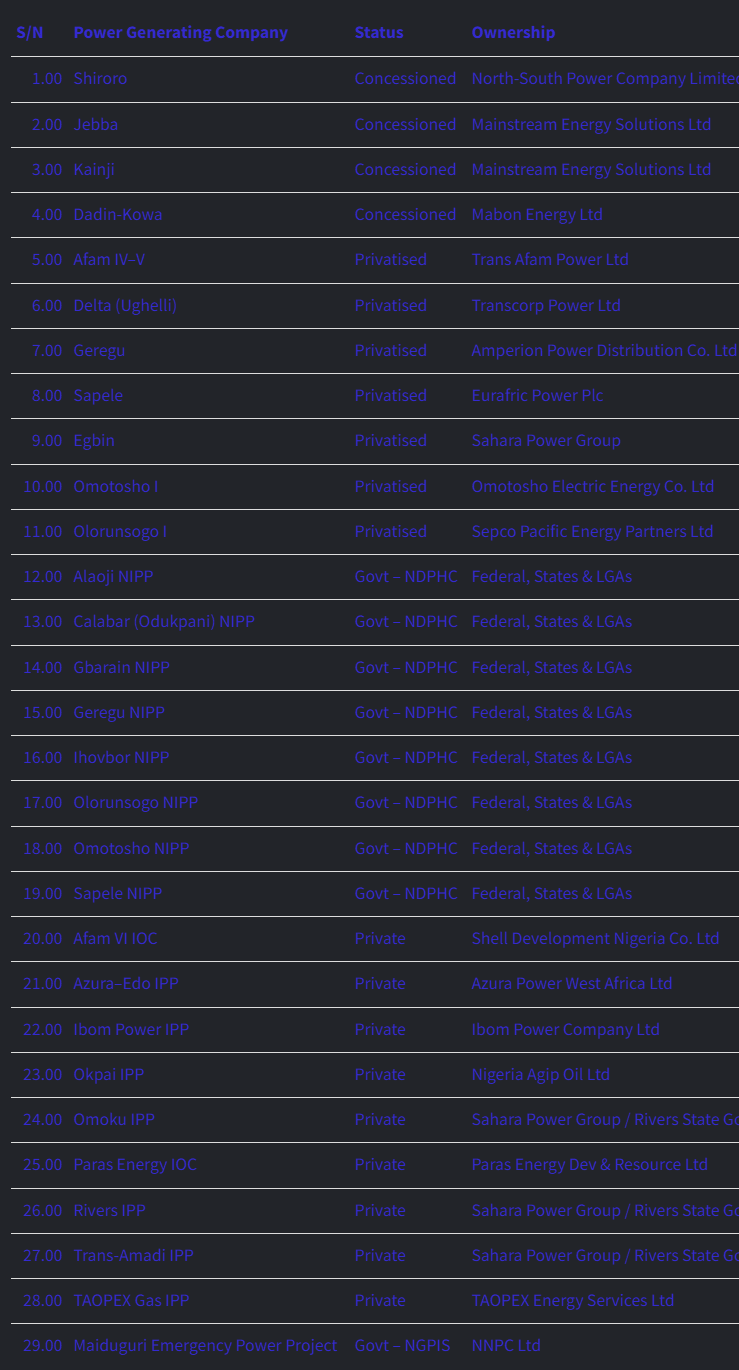
By 2025, Nigeria had 29 grid-connected generation companies (GenCos), with 25 relying on gas and only four utilizing hydropower.
The privatization of Nigeria’s power sector is widely regarded as one of the most ambitious global power sector initiatives of the past decade, with a transaction value of approximately $3 billion.
Here is a list of GenCos in Nigeria:
Electricity Transmission Companies (TransCos )
Transmission companies, AKA TransCos, transmit electricity to DisCos. There is only one body responsible for the transmission of electricity in Nigeria—TCN (now TSP). Until 2024, the TCN was a single entity, but was unbundled into two separate entities: TSP (Transmission Service Provider) and Nigerian Independent System Operator Nigeria Limited (NISO).
TCN still retains the TSP license, and is responsible for overseeing the physical infrastructure of the national grid (power lines, substations, towers, etc) and their maintenance and expansion. NISO handles crucial functions of the System Operations department (managing the flow of electricity to ensure grid stability) and the Market Operations department (administering market rules and financial settlements).
This separation of roles was enacted in April 2024 in line with the Electricity Act 2023. This was done to increase transparency, improve efficiency, and enhance the overall reliability of Nigeria's power sector.
TransCos takes electricity from GenCos and “transports” it across the country on a high voltage bus, because electricity needs to be transported at high voltage to reduce electrical losses when moving power across long distances.
Electricity Distribution Companies (DisCos)
DisCos are the third part of the Nigerian Electricity Supply Industry. DisCos are responsible for delivering electricity from the transmission grid to end-users in specific regions.
DisCos are the closest entities to the consumers in the Nigerian Electricity Supply Industry. They communicate directly with the consumer, and the consumers pay directly to the DisCos.
Money flows from the bottom to the top in the Nigerian Electricity Supply Industry, from consumers to DisCos to TransCos, and then to GenCos, who pay gas suppliers and other suppliers of fossil fuels and machinery that are used in the generation of electricity.
Until July 2024, NBET acted as the sole electricity trading intermediary between DisCos and GenCos. But now there is a liberal market model that allows for competitive trading of electricity.
There are currently 11 active Discos in Nigeria, including:
1. Abuja Electricity Distribution Company (AEDC) – covers the Federal Capital Territory and parts of Niger, Kogi, and Nasarawa States.
2. Benin Electricity Distribution Company (BEDC) – covers Edo, Delta, and parts of Ondo States.
3. Eko Electricity Distribution Company (EKEDC, also commonly called: Eko DisCo) – covers Lagos and parts of Ogun State.
4. Enugu Electricity Distribution Company (EEDC, also commonly called: Enugu DisCo) – covers Enugu, Anambra, Ebonyi, and parts of Abia and Imo States.
5. Ibadan Electricity Distribution Company (IBEDC) – covers Oyo, Ogun, and parts of Kwara and Ondo States.
6. Ikeja Electricity Distribution Company (IKEDC) – covers Ikeja and parts of Lagos State.
7. Jos Electricity Distribution Company (JEDC) – covers Plateau, Bauchi, Benue, and parts of Nasarawa States.
8. Kano Electricity Distribution Company (KEDCO) – covers Kano, Jigawa, and Katsina States.
9. Kaduna Electricity Distribution Company (KEDC) – covers Kaduna, Kebbi, Sokoto, and Katsina States.
10. Port Harcourt Electricity Distribution Company (PHEDC) – covers Rivers, Bayelsa, and parts of Abia and Imo States.
11. Yola Electricity Distribution Company (YEDC) – covers Adamawa, Taraba, Gombe, Yobe, and Borno States.
The Nigerian Electricity Regulatory Commission
The Nigerian Electricity Regulatory Commission (NERC) is the sole entity responsible for managing the electricity sector. It is the most important entity in the Nigerian Electricity Supply Industry (NESI). The NERC issues licences to DisCos, GenCos, and even captive power plants. The NERC ensures that tariff levels are set fairly and adequately to generate significant revenue.
The NERC protects consumer rights by setting standards for service delivery, creating regulations, and providing ways or channels to make their complaints. Consumer rights under NERC’s purview include: the right to a reliable electricity supply, a functioning meter, accurate billing, and being notified before disconnection.
You can make complaints to the NERC Forum, a body set up by the NERC to perform its duties under the Electric Power Sector Reform Act of 2005 (ESPR 2005) to receive and deliberate upon appeals on decisions made by the Customer Complaint Units of Electricity Distribution Companies (DisCos).
Customers have to file their complaint to DisCos in writing, and if the customers are not satisfied with the DisCo’s resolution or there is a delay, then they can escalate it to the NERC. You can make a complaint through the NERC call center by calling 02013444331 / 090888999244 or sending an email to compliants@nerc.gov.ng.
Limitations of NESI (Nigerian Electricity Supply Industry)
Despite reforms, privatization, and new regulatory frameworks, NESI continues to face deep, systemic challenges that restrict a stable power supply. These limitations exist across generation, transmission, distribution, and market coordination.
Below are the key challenges affecting the Nigerian Electricity Supply Industry:
1. Limited Generation Capacity
Nigeria generates a total installed electricity capacity of approximately 13,625 MW, but only manages to generate and dispatch 4000 MW on average. This is because of gas shortages, ageing plants, poor maintenance, and debts owed to GenCos, which reduces their capacity to maintain plants. This means even though the country has the infrastructure to produce more power, only a fraction is actually available to the grid.
2. Weak and Ageing Transmission Infrastructure
The national grid is old, overloaded, and lacks enough lines and substations needed to move electricity efficiently. This fragile system often collapses under stress, preventing reliable power delivery across the country.
3. High Technical, Commercial & Collection Losses
A large portion of electricity is lost due to weak infrastructure, energy theft, unmetered customers, and poor billing practices. These losses reduce revenue and weaken the entire industry’s financial stability.
4. Liquidity Crisis
Some consumers fail to pay for electricity, avoid bills, or bypass meters, so DisCos cannot fully pay TSP/NISO or GenCos. GenCos then struggle to pay gas suppliers. This broken revenue chain creates a cycle of debt that reduces generation and investment.
5. Low Metering Levels
Over 7.2 million Nigerians still rely on estimated billing because they do not have meters. This fuels customer distrust, encourages energy theft, and makes it difficult for DisCos to collect accurate revenue.
6 Slow Adoption of Decentralized Power Solutions
Nigeria relies heavily on the national grid instead of aggressively expanding mini-grids, embedded generation, and solar systems. This slows electrification and keeps pressure on an already weak national grid.
TL;DR….
- Electricity is generated by GenCos, transmitted by TSP/NISO, and delivered to consumers by DisCos, with NERC regulating the entire chain.
- Since 2013, generation and distribution have been privatized, while transmission remains government-controlled. This improved structure, but didn’t eliminate operational inefficiencies.
Frequently Asked Questions
What is the full meaning of DisCos in Nigeria?
DisCos is an acronym for distribution companies in Nigeria, and it refers to private companies that are responsible for distributing electricity from the transmission network to end users.
Who are the GenCos in Nigeria?
GenCos in Nigeria are electricity generation companies; they typically use hydro and gas power plants.
How Many DisCos are there in Nigeria?
There are 11 active DisCos in Nigeria. They include: Abuja Electricity Distribution Company (AEDC), Benin Electricity Distribution Company (BEDC), Eko Electricity Distribution Company (EKEDC), Enugu Electricity Distribution Company (EEDC), Ikeja Electric (IE), Jos Electricity Distribution Company (JEDC), Kaduna Electricity Distribution Company (KAEDC), Kano Electricity Distribution Company (KEDC), Port Harcourt Electricity Distribution Company (PHEDC), and Yola Electricity Distribution Company (YEDC).
What is the role of NERC in Nigeria?
The role of NERC is to ensure standards of performance in the Nigerian Electricity Supply Industry are regulated and met.
Stay Ahead of NESI Limitations With Pai Enterprise
Nigeria’s power sector is complex, but your business shouldn’t have to struggle because of it. Pai Enterprise helps organisations plan smarter, operate more efficiently, and reduce exposure to the weaknesses in the national grid. From intelligent energy monitoring and energy management to sizing optimisation, we enable you to make data-driven decisions that keep your operations stable, resilient, and cost-effective, no matter how the Nigerian Electricity Supply Industry performs. Book a free demo to stay ahead of NESI limitations when you click this link.